Wednesday, April 14, 2010

Walk 12: Time Travel, Tricks, and Treats around Saint-Sulpice

Did Saint Sulpice ring a bell? Yep, you've got it, it's the church made famous by The DaVinci Code, where Silas, the monk, goes in search of the Grail. It's the second-largest church in Paris, but I'm afraid it's not much to look at. This is me with the gnomon and the meridian line, which are also key in The DaVinci Code.

Besides the church, this walk encompassed a couple of pastry shops, a figurine store, and a statue of a centaur. But these were my favorite finds:


An old lady carrying a black cat in a birdcage and a mattress, leaned up against a building for safe keeping. Sometimes, Paris surprises you. Actually, all the time.

Walk 4: Of Art, War, and World's Fairs: Invalides, Musée Rodin, Tour Eiffel

This walk didn't get done all in one day, and in fact may have taken three different occasions to finish, because it is chock-full o' amazing things.

We started with les Grand et Petit Palais, both of which were built for the World's Fair of 1900, and now are home to various art exhibits.


Crossing the Pont Alexandre III,


and heading left, we come to the Rodin Museum, far and away one of my favorite places in Paris. Stunning. Absolutely magnificent. Rodin is Michelangelo after it was no longer cool to be Michelangelo. Every single one of his sculptures looks living, looks breathing, looks pensive, looks desperate, looks real. I love them all.


Barely a block away is Les Invalides, a hospital built by Louis XIV to house wounded and elderly veterans. It still serves that purpose, but it also the final resting place of Napoleon Bonaparte, and includes a war museum.

Yeah, that's the Napoleon's hat and coat. I'm almost jealous of myself, it's so cool.

Et, finalement, La Tour Eiffel, that international symbol for Paris. It's HUGE. It towers over everything, and when it was built (history lesson: by Gustave Eiffel in 1889 for the World's Fair) it was the tallest building in the world. It weighs over 10,000 tons and requires 60 tons of paint to cover it fully. I love it. Who am I kidding though, I love everything here.

Walk 13: Seizième Arrondissement Walk

Paris is divided into 2o arrondissements, kind of like large neighborhoods, each with their own feel. It's not uncommon, when receiving directions, or in asking where someone lives, to get a response that includes the number of the arrondissement. The sixteenth, where this walk is based, is upper-class, away from the major tourist attractions, and almost entirely residential.


I know, it's supposed to be in New York. Auguste Bartholdi, the guy who created the Statue of Liberty that we know, first made this one as a scale model. Actually, I've seen several statues of liberty since I've been here--another tiny one is in the Jardin du Luxembourg.

Paris couldn't get enough Art Nouveau--a lot of the metro entrances are decorated in the style, and, in the seizieme, so are many of the buildings. Behold, Castel Beranger, an apartment building designed by Hector Guimard, the work of whom has left me completely smitten.


The Jardins du Ranelagh boasted bike paths, donkey rides, and this carousel, where kids ride horses and are given a tiny lance, like they're jousting, and have to try to hook their lance through a small ring along the edge of the carousel. There was probably something historical in the park that I was supposed to notice, but this was just so much more fun to photograph.

Walk 2: Metro Walk

I didn't have my camera with me when we did this one but, I've got to say, if this entry is boring, it only reflects the nature of the walk. Maybe I'm unappreciative (in fact I know I am), but I just didn't care about the history of the metro. It's there. I use it. Daily. That's all I need to know, right? That, and how to read this map:


It's really not as bad as it looks. It took maybe a week and a half before I was comfortable reading it, another week before I was brave enough to leave home without it, and it's just been within the last month that I have parts of it memorized, and could tell you that if you're by the Eiffel Tower and want to get to the Opera Bastille, you should hope on the 8 at Ecole Militaire, going toward Creteil, switch to the 1 toward Chateau de Vincennes at Concorde, and ride it to Bastille. It's fewer stops than taking the 8 all the way, trust me. All without looking. I'm pretty proud of myself, given how directionally-challenged I am.

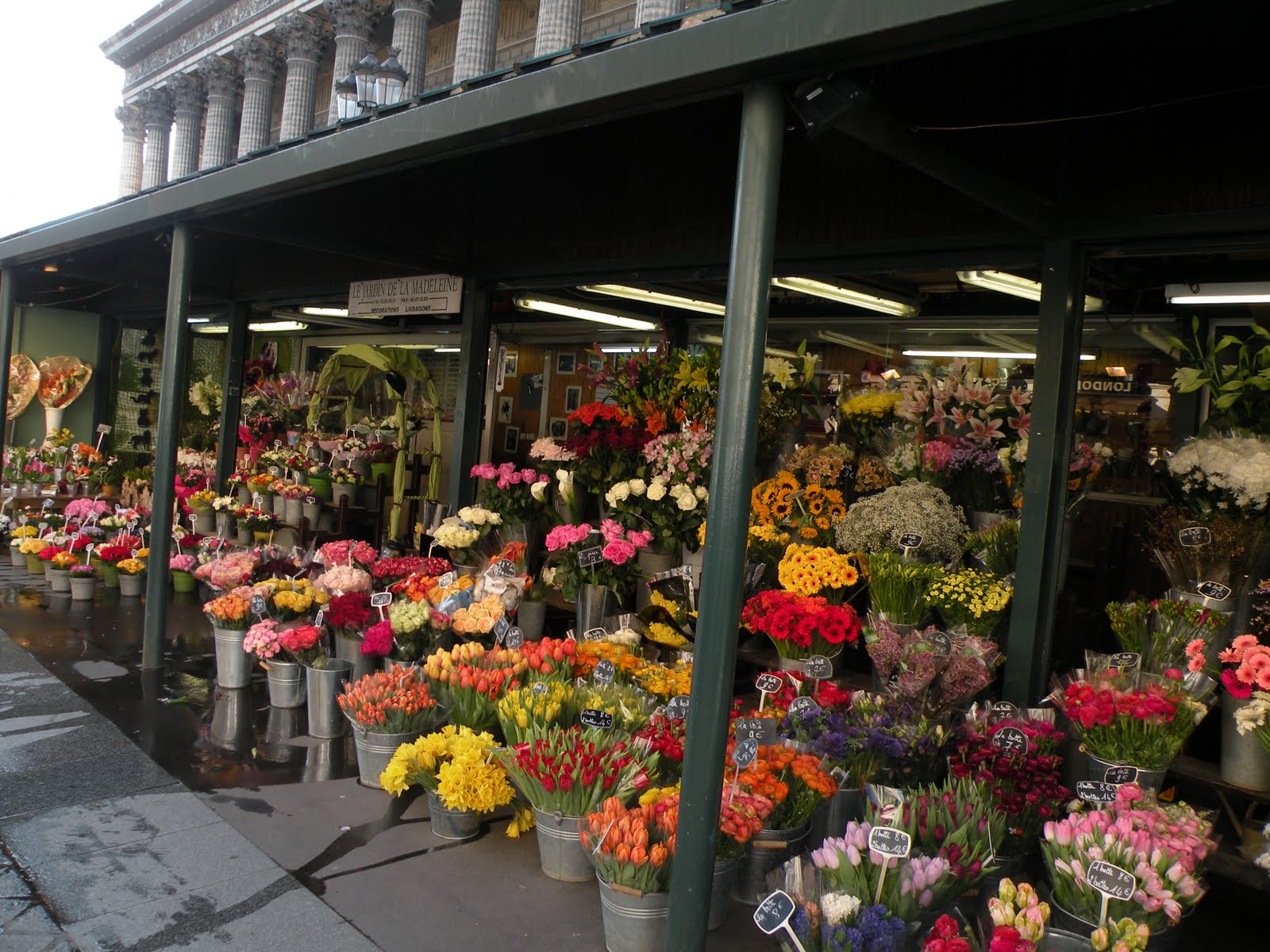
Walk 6: Marcher le nez au vent: Sights and smells around the Madeleine.


The Madeleine church began as one of Napoleon's many monuments to his own military power, and was built in the style of a pagan temple. Upon the rise of Louis XVIII, however, the building was renovated and updated into a Catholic church, which it still is today. So, for all its Greek columns, there is still a Catholic Parish-run restaurant in the basement, where my host-mom serves meals for the reasonable price of 7,50 on Wednesday afternoons, for the benefit of charity.


Ooh, I almost forgot the part that makes this walk fragrant. Hooray for Parisian flower markets--they make the winter here so much brighter!

Walk 20: La Route des Manifs: Canal Saint-Martin, République, Bastille, Viaduc des Arts

Remember that scene in Amelie where they introduce each character by showing you their likes and dislikes? And remember how Amelie likes skipping stones at the Canal Saint-Martin? That's where this is:


Gross. Having been in Paris then, during what is surely its ugliest season, and seeing it now, as it's just beginning to blossom into Spring, I don't want to leave. Suddenly there are leaves on all of the trees, water gushing from every fountain, and sunlight streaming through my window in the morning. It is simply glorious.

But on to something more grisly. La Place de la Bastille is the site of the prison that was stormed on July 14, 1789, during the French Revolution. The prison is no longer standing (those revolutionaries and their destructive tendencies, again), but in its place is this, the Genie of Liberty.


Ready for the grisly part? In the base of the column are the remains of 500 victims of the revolutions of 1830 and 1848 (the overthrows of Charles X and Louis-Philippe, respectively). The French have some strange ideas about honoring their dead. If you don't believe me, ask me about the Incorruptible Saints or the Catacombs.

And, lastly, this is the Viaduc des Arts.


I love it. It was originally the base of a railroad, but has spent the last 15 or so years housing various artisan shops. Amazing artisan shops. I saw a chandelier that was in the shape of a ship, complete with masts. Think Peter Pan. I went into a store devoted entirely to cross-stitching, and watched from the window of another as a sculptor blew glass. I really feel like Paris takes more pride in their shopping than we do. Maybe that sounds frivolous, but it's not. Parisians want the best, so, here, they make the best.

Walk 14: Eighteenth-Century Lifestyles of the Rich and Famous: Musée Jacquemart-André, Musée Nissim de Camondo, Parc Monceau

Museums, museums, museums. It's funny, I feel like I spend half of my time in Paris in one museum or another (the other half is spent on the metro), taking pictures of things I really had no desire to see in the first place. There are some notable exceptions, like some of the astonishing paintings and sculptures in the Louvre, L'Orangerie, the Musée Rodin, and the Musée d'Orsay (okay now that I'm listing, it almost looks like there were more exceptions that anything else), but, for the most part, I'm just not a museum person. For every one piece that really strikes me, really moves me, there are about a hundred that I can't wait to forget. And so, when I somehow become absurdly wealthy, I will purchase every piece that I like (watch out, Rodin Museum, you're going to be wiped clean), and none that I do not, and will live out my days happily among my VanGoghs and Gauguins. It's the only way.

What started that daydream? Visits to two preserved eighteenth-century houses, one of which I loved, the other of which I did not, and neither of which I have pictures for (I know, I ended that sentence with a preposition, but it got really complicated otherwise). The Musée Jacquemart-André has the coolest double staircase I've ever seen/climbed, and it leads to a second-story balcony-type thing facing a beautiful Italian fresco and overlooking a sort of plant-filled foyer. Use your imagination.

This is from the outside:


I love me some lions.

Parc Monceau is beautiful (but I'm a sucker for anything green), and full of ruins, like this:


Cool, huh? Yeah, I thought so too until I found out that they were built in the 1800s because ruins were the "it" thing. Kind of like pre-torn jeans.

Also at Parc Monceau: this elementary school gym class obstacle course that I, for some reason, found really amusing. I think it was the teacher's Adidas windbreaker pants that did it.