Wednesday, April 14, 2010

Walk 5: Place de la Concorde

This walk took me past a bunch of government buildings, including the Palais de l'Elysée, which is the French equivalent to the White House, and the U.S. Embassy, neither of which I could actually go into.

Place de la Concorde is a large square in front of the Tuileries, and has been the site of a number of important historical events throughout the centuries. Here, Benjamin Franklin signed into an alliance with France in 1778, guaranteeing the colonies' protection of France's assets in North America. At the time of the Revolution, the square served as the space for public executions à la guillotine, including that of Marie Antoinette.

In the very center of la Place is an Egyptian obelisk. I know, random. It was a gift to Charles X from Egyptian governor Mohammed Ali in 1829, and its granite comes from the ruins along the Nile. It's more than 3,000 years old.


Aaaaand with that, I went to the Tuileries and almost fell asleep in the sun. The perfect end to any walk.

Walk 17: Small Buildings Need Not Apply: La Défense

This is another one where I didn't have my camera with me. A few of us were grabbing food at the mall at La Défense, and decided to make a walk out of it. I can't say that I'm all that glad that we did.

Paris is old. Old and beautiful and brimming with history, and it hurts a little bit to see skyscrapers towering above the city. I understand the need for new development, especially in this town, where strict policies make it nearly impossible to renovate anything, for history's sake, and if I lived here permanently, maybe I'd appreciate a new building here and there. But I don't live here permanently, and, as a long-term tourist, I wish Paris could be all Notre Dames and Sacré Coeurs, and 18th century hotels.

That being said I'm sure that these are the same things people said when they constructed the Eiffel Tower and the glass pyramid at the Louvre, both of which I love. Plus, the thumb was kind of cool, in a creepy way.

Walk 12: Time Travel, Tricks, and Treats around Saint-Sulpice

Did Saint Sulpice ring a bell? Yep, you've got it, it's the church made famous by The DaVinci Code, where Silas, the monk, goes in search of the Grail. It's the second-largest church in Paris, but I'm afraid it's not much to look at. This is me with the gnomon and the meridian line, which are also key in The DaVinci Code.

Besides the church, this walk encompassed a couple of pastry shops, a figurine store, and a statue of a centaur. But these were my favorite finds:


An old lady carrying a black cat in a birdcage and a mattress, leaned up against a building for safe keeping. Sometimes, Paris surprises you. Actually, all the time.

Walk 4: Of Art, War, and World's Fairs: Invalides, Musée Rodin, Tour Eiffel

This walk didn't get done all in one day, and in fact may have taken three different occasions to finish, because it is chock-full o' amazing things.

We started with les Grand et Petit Palais, both of which were built for the World's Fair of 1900, and now are home to various art exhibits.


Crossing the Pont Alexandre III,


and heading left, we come to the Rodin Museum, far and away one of my favorite places in Paris. Stunning. Absolutely magnificent. Rodin is Michelangelo after it was no longer cool to be Michelangelo. Every single one of his sculptures looks living, looks breathing, looks pensive, looks desperate, looks real. I love them all.


Barely a block away is Les Invalides, a hospital built by Louis XIV to house wounded and elderly veterans. It still serves that purpose, but it also the final resting place of Napoleon Bonaparte, and includes a war museum.

Yeah, that's the Napoleon's hat and coat. I'm almost jealous of myself, it's so cool.

Et, finalement, La Tour Eiffel, that international symbol for Paris. It's HUGE. It towers over everything, and when it was built (history lesson: by Gustave Eiffel in 1889 for the World's Fair) it was the tallest building in the world. It weighs over 10,000 tons and requires 60 tons of paint to cover it fully. I love it. Who am I kidding though, I love everything here.

Walk 13: Seizième Arrondissement Walk

Paris is divided into 2o arrondissements, kind of like large neighborhoods, each with their own feel. It's not uncommon, when receiving directions, or in asking where someone lives, to get a response that includes the number of the arrondissement. The sixteenth, where this walk is based, is upper-class, away from the major tourist attractions, and almost entirely residential.


I know, it's supposed to be in New York. Auguste Bartholdi, the guy who created the Statue of Liberty that we know, first made this one as a scale model. Actually, I've seen several statues of liberty since I've been here--another tiny one is in the Jardin du Luxembourg.

Paris couldn't get enough Art Nouveau--a lot of the metro entrances are decorated in the style, and, in the seizieme, so are many of the buildings. Behold, Castel Beranger, an apartment building designed by Hector Guimard, the work of whom has left me completely smitten.


The Jardins du Ranelagh boasted bike paths, donkey rides, and this carousel, where kids ride horses and are given a tiny lance, like they're jousting, and have to try to hook their lance through a small ring along the edge of the carousel. There was probably something historical in the park that I was supposed to notice, but this was just so much more fun to photograph.

Walk 2: Metro Walk

I didn't have my camera with me when we did this one but, I've got to say, if this entry is boring, it only reflects the nature of the walk. Maybe I'm unappreciative (in fact I know I am), but I just didn't care about the history of the metro. It's there. I use it. Daily. That's all I need to know, right? That, and how to read this map:


It's really not as bad as it looks. It took maybe a week and a half before I was comfortable reading it, another week before I was brave enough to leave home without it, and it's just been within the last month that I have parts of it memorized, and could tell you that if you're by the Eiffel Tower and want to get to the Opera Bastille, you should hope on the 8 at Ecole Militaire, going toward Creteil, switch to the 1 toward Chateau de Vincennes at Concorde, and ride it to Bastille. It's fewer stops than taking the 8 all the way, trust me. All without looking. I'm pretty proud of myself, given how directionally-challenged I am.

Walk 6: Marcher le nez au vent: Sights and smells around the Madeleine.


The Madeleine church began as one of Napoleon's many monuments to his own military power, and was built in the style of a pagan temple. Upon the rise of Louis XVIII, however, the building was renovated and updated into a Catholic church, which it still is today. So, for all its Greek columns, there is still a Catholic Parish-run restaurant in the basement, where my host-mom serves meals for the reasonable price of 7,50 on Wednesday afternoons, for the benefit of charity.


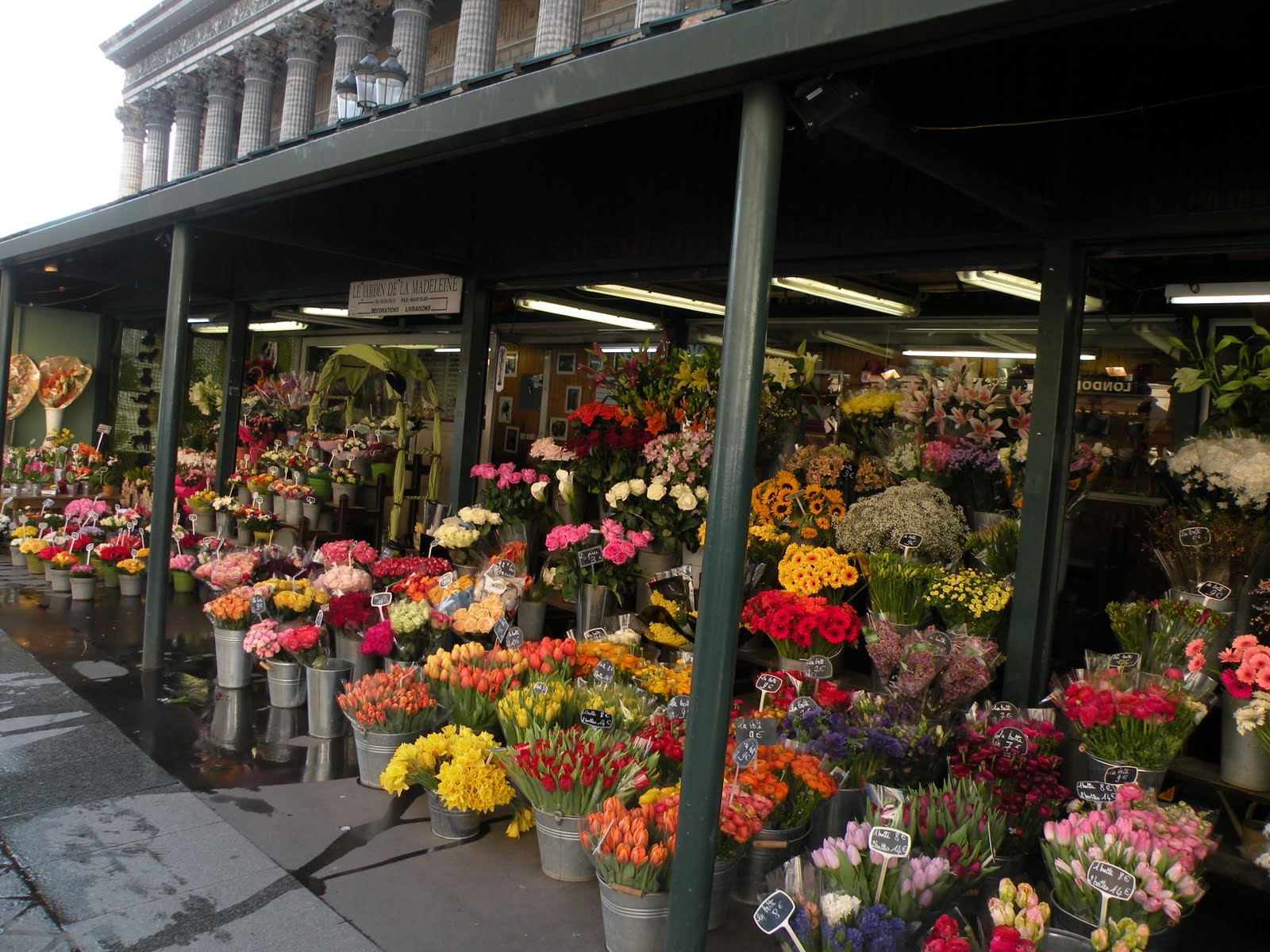
Ooh, I almost forgot the part that makes this walk fragrant. Hooray for Parisian flower markets--they make the winter here so much brighter!