It's really not as bad as it looks. It took maybe a week and a half before I was comfortable reading it, another week before I was brave enough to leave home without it, and it's just been within the last month that I have parts of it memorized, and could tell you that if you're by the Eiffel Tower and want to get to the Opera Bastille, you should hope on the 8 at Ecole Militaire, going toward Creteil, switch to the 1 toward Chateau de Vincennes at Concorde, and ride it to Bastille. It's fewer stops than taking the 8 all the way, trust me. All without looking. I'm pretty proud of myself, given how directionally-challenged I am.
Wednesday, April 14, 2010
Walk 2: Metro Walk
I didn't have my camera with me when we did this one but, I've got to say, if this entry is boring, it only reflects the nature of the walk. Maybe I'm unappreciative (in fact I know I am), but I just didn't care about the history of the metro. It's there. I use it. Daily. That's all I need to know, right? That, and how to read this map:

It's really not as bad as it looks. It took maybe a week and a half before I was comfortable reading it, another week before I was brave enough to leave home without it, and it's just been within the last month that I have parts of it memorized, and could tell you that if you're by the Eiffel Tower and want to get to the Opera Bastille, you should hope on the 8 at Ecole Militaire, going toward Creteil, switch to the 1 toward Chateau de Vincennes at Concorde, and ride it to Bastille. It's fewer stops than taking the 8 all the way, trust me. All without looking. I'm pretty proud of myself, given how directionally-challenged I am.
Walk 6: Marcher le nez au vent: Sights and smells around the Madeleine.
The Madeleine church began as one of Napoleon's many monuments to his own military power, and was built in the style of a pagan temple. Upon the rise of Louis XVIII, however, the building was renovated and updated into a Catholic church, which it still is today. So, for all its Greek columns, there is still a Catholic Parish-run restaurant in the basement, where my host-mom serves meals for the reasonable price of 7,50 on Wednesday afternoons, for the benefit of charity.
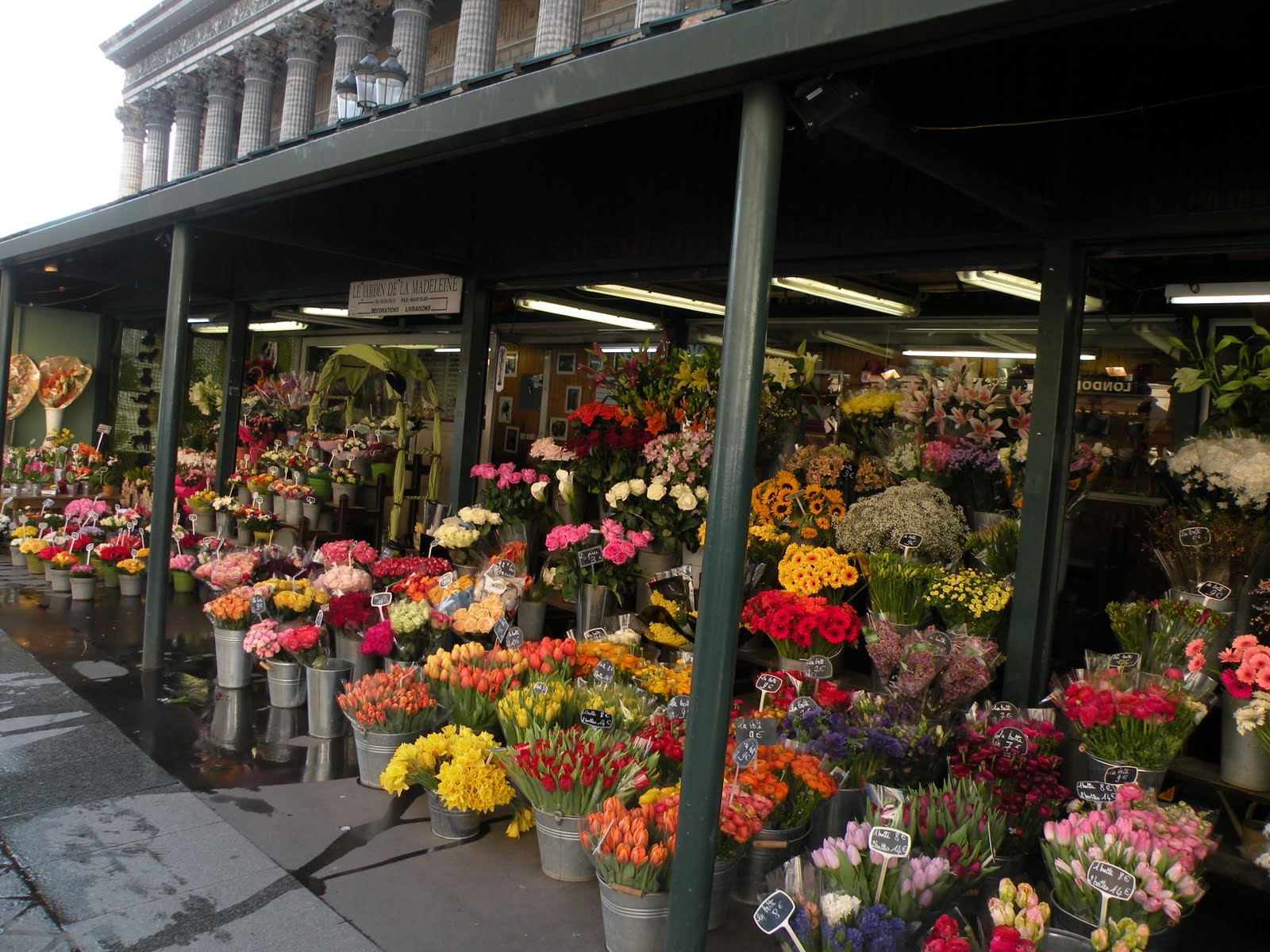
Ooh, I almost forgot the part that makes this walk fragrant. Hooray for Parisian flower markets--they make the winter here so much brighter!
Walk 20: La Route des Manifs: Canal Saint-Martin, République, Bastille, Viaduc des Arts
Remember that scene in Amelie where they introduce each character by showing you their likes and dislikes? And remember how Amelie likes skipping stones at the Canal Saint-Martin? That's where this is:

Gross. Having been in Paris then, during what is surely its ugliest season, and seeing it now, as it's just beginning to blossom into Spring, I don't want to leave. Suddenly there are leaves on all of the trees, water gushing from every fountain, and sunlight streaming through my window in the morning. It is simply glorious.
But on to something more grisly. La Place de la Bastille is the site of the prison that was stormed on July 14, 1789, during the French Revolution. The prison is no longer standing (those revolutionaries and their destructive tendencies, again), but in its place is this, the Genie of Liberty.

Ready for the grisly part? In the base of the column are the remains of 500 victims of the revolutions of 1830 and 1848 (the overthrows of Charles X and Louis-Philippe, respectively). The French have some strange ideas about honoring their dead. If you don't believe me, ask me about the Incorruptible Saints or the Catacombs.
And, lastly, this is the Viaduc des Arts.

I love it. It was originally the base of a railroad, but has spent the last 15 or so years housing various artisan shops. Amazing artisan shops. I saw a chandelier that was in the shape of a ship, complete with masts. Think Peter Pan. I went into a store devoted entirely to cross-stitching, and watched from the window of another as a sculptor blew glass. I really feel like Paris takes more pride in their shopping than we do. Maybe that sounds frivolous, but it's not. Parisians want the best, so, here, they make the best.
Gross. Having been in Paris then, during what is surely its ugliest season, and seeing it now, as it's just beginning to blossom into Spring, I don't want to leave. Suddenly there are leaves on all of the trees, water gushing from every fountain, and sunlight streaming through my window in the morning. It is simply glorious.
But on to something more grisly. La Place de la Bastille is the site of the prison that was stormed on July 14, 1789, during the French Revolution. The prison is no longer standing (those revolutionaries and their destructive tendencies, again), but in its place is this, the Genie of Liberty.
Ready for the grisly part? In the base of the column are the remains of 500 victims of the revolutions of 1830 and 1848 (the overthrows of Charles X and Louis-Philippe, respectively). The French have some strange ideas about honoring their dead. If you don't believe me, ask me about the Incorruptible Saints or the Catacombs.
And, lastly, this is the Viaduc des Arts.
I love it. It was originally the base of a railroad, but has spent the last 15 or so years housing various artisan shops. Amazing artisan shops. I saw a chandelier that was in the shape of a ship, complete with masts. Think Peter Pan. I went into a store devoted entirely to cross-stitching, and watched from the window of another as a sculptor blew glass. I really feel like Paris takes more pride in their shopping than we do. Maybe that sounds frivolous, but it's not. Parisians want the best, so, here, they make the best.
Walk 14: Eighteenth-Century Lifestyles of the Rich and Famous: Musée Jacquemart-André, Musée Nissim de Camondo, Parc Monceau
Museums, museums, museums. It's funny, I feel like I spend half of my time in Paris in one museum or another (the other half is spent on the metro), taking pictures of things I really had no desire to see in the first place. There are some notable exceptions, like some of the astonishing paintings and sculptures in the Louvre, L'Orangerie, the Musée Rodin, and the Musée d'Orsay (okay now that I'm listing, it almost looks like there were more exceptions that anything else), but, for the most part, I'm just not a museum person. For every one piece that really strikes me, really moves me, there are about a hundred that I can't wait to forget. And so, when I somehow become absurdly wealthy, I will purchase every piece that I like (watch out, Rodin Museum, you're going to be wiped clean), and none that I do not, and will live out my days happily among my VanGoghs and Gauguins. It's the only way.
What started that daydream? Visits to two preserved eighteenth-century houses, one of which I loved, the other of which I did not, and neither of which I have pictures for (I know, I ended that sentence with a preposition, but it got really complicated otherwise). The Musée Jacquemart-André has the coolest double staircase I've ever seen/climbed, and it leads to a second-story balcony-type thing facing a beautiful Italian fresco and overlooking a sort of plant-filled foyer. Use your imagination.
This is from the outside:

I love me some lions.
Parc Monceau is beautiful (but I'm a sucker for anything green), and full of ruins, like this:

Cool, huh? Yeah, I thought so too until I found out that they were built in the 1800s because ruins were the "it" thing. Kind of like pre-torn jeans.
Also at Parc Monceau: this elementary school gym class obstacle course that I, for some reason, found really amusing. I think it was the teacher's Adidas windbreaker pants that did it.
What started that daydream? Visits to two preserved eighteenth-century houses, one of which I loved, the other of which I did not, and neither of which I have pictures for (I know, I ended that sentence with a preposition, but it got really complicated otherwise). The Musée Jacquemart-André has the coolest double staircase I've ever seen/climbed, and it leads to a second-story balcony-type thing facing a beautiful Italian fresco and overlooking a sort of plant-filled foyer. Use your imagination.
This is from the outside:
I love me some lions.
Parc Monceau is beautiful (but I'm a sucker for anything green), and full of ruins, like this:
Cool, huh? Yeah, I thought so too until I found out that they were built in the 1800s because ruins were the "it" thing. Kind of like pre-torn jeans.
Also at Parc Monceau: this elementary school gym class obstacle course that I, for some reason, found really amusing. I think it was the teacher's Adidas windbreaker pants that did it.
Sunday, March 28, 2010
Walk 3: A Walk in the Park: Montparnasse and the Jardin du Luxembourg
I probably should have saved this walk for April. I don't know if I've made it clear, but winter in Paris is miserable, weather-wise. SO FREAKING COLD. That whiny-ness out of the way, this was a refreshingly simple walk, without too much history for me to botch.
This is a statue of Alfred Dreyfus.
We don't know what the deal with the balloon was, but it bothered Chelsea. So she removed it.
Dreyfus was a Jewish army captain falsely accused of sharing military secrets in 1894. Based on evidence from a forged note, he was convicted of treason, forced from his position, and exiled. France has a pretty solid history of religious discrimination, and the Dreyfus Affair, as it came to be known, happened at a time when an influx of Jewish immigration in Paris was spawning antisemitism. It took over ten years for the state to admit its mistake and bring Dreyfus back from exile. The affair, in the meantime, had caused a national crisis that culminated in Emile Zola's inflammatory article, J'accuse. The issue provoked a division in the country, as Dreyfus symbolized, according to historian Alistair Horne, "either the eternal Jewish traitor or the denial of justice." Nationalism vs. Humanism. Tough call. This statue was supposed to be on display at the École Militaire, where the original injustice against Dreyfus was committed, but the French are still touchy about l'affaire, and have instead hidden it away, where only people on this walk will find it.
On to the Jardin du Luxembourg. It's much prettier now that there are kids running around and the trees are in bloom, but you get the idea:
The Orangerie, where orange trees and other plants have been housed since the mid-19th century, and where, as a nice old man in a checkered hat explained to us, an art exhibition had taken place the week before. Just missed it!
Pond in front of the Palais du Luxembourg. Again, I went back this week, and it's so much nicer now that the fountains are flowing, birds are chirping, and it's warm enough to want to stay.
Woman feeding the ducks on the frozen water of the Fontaine Médicis.
C'est tout!
Saturday, March 6, 2010
Walk 11: Lutetia Pulchra Est: Museé National du Moyen Âge, Sorbonne, Pantheon, Saint-Etienne-du-Mont, Arènes de Lutèce
The title says it all. This has been one of my favorite walks so far--it's chock full o' history! We started at the Middle Ages, or Cluny Museum. My favorite parts were the rooms full of stained glass--there's something that's both so beautiful and so solemn about it.

But la pièce de résistance was La dame à la lincorne, a series of tapestries from around the 16th century. They were in their own, semi-circular temperature-controlled room with a little video screen playing some dramatic PBS-type presentation about them. I just think it's funny how every museum has its one or two "big" pieces (the Louvre and the Mona Lisa, the Orangerie and the Water Lilies, etc.) and they usually end up just not living up to the hype. Some of my favorite pieces, especially in the Louvre, are works I'd never heard of, by artists whose names I'd never seen. And that's been one of my favorite things to do here--explore all that a museum or famous architectural site has to offer.

The Pantheon. The first thing I thought was "cold." It was so chilly inside that it hurt to try to bend my fingers by the time we left. The architecture and murals were beautiful, but it was the crypt that made the Pantheon really memorable. The French place a really fascinating emphasis on their dead; their great writers, politicians, and royalty are interred with great care, often in beautiful tombs or in symbolic locations. This fixation on remains works both ways, however. Historically, revolutionaries have had no qualms about digging up and burning, scattering, and otherwise desecrating the remains of those people who espoused whatever it is they were rebelling against.
Case in point: Saint Geneviéve. The patron saint of Paris, she is said to have diverted an attack by Attila's Huns around the year 450, saving Paris through her prayers. Upon her death, her remains were housed at various churches until Louis XV ordered a new church (what is now the Pantheon) be built for the express purpose of their residence. They were, however, burnt by revolutionaries in 1793, and all that remains in her honor is a little bit of her sarcophagus, on display at Saint-Etienne-du-Mont, a little church directly next to the Pantheon.

The more I read about French history, and the more I'm surrounded by it, the more contradictory it all seems. On one hand, the French care a great deal about preserving their history, their buildings, relics, prestigious citizens, etc., and always have. But the second anything changes (be it a change in the monarchy or the Revolution), it's out with the old, in with the new. Everything is so extreme, like there couldn't just be a happy medium. One minute everyone is glorifying the dauphin, and the next they're burning him in effigy. I kind of like it, though. It makes everything seem bigger, grander, more important and consuming, and makes the French seem altogether more passionate, for better or for worse.
But la pièce de résistance was La dame à la lincorne, a series of tapestries from around the 16th century. They were in their own, semi-circular temperature-controlled room with a little video screen playing some dramatic PBS-type presentation about them. I just think it's funny how every museum has its one or two "big" pieces (the Louvre and the Mona Lisa, the Orangerie and the Water Lilies, etc.) and they usually end up just not living up to the hype. Some of my favorite pieces, especially in the Louvre, are works I'd never heard of, by artists whose names I'd never seen. And that's been one of my favorite things to do here--explore all that a museum or famous architectural site has to offer.
The Pantheon. The first thing I thought was "cold." It was so chilly inside that it hurt to try to bend my fingers by the time we left. The architecture and murals were beautiful, but it was the crypt that made the Pantheon really memorable. The French place a really fascinating emphasis on their dead; their great writers, politicians, and royalty are interred with great care, often in beautiful tombs or in symbolic locations. This fixation on remains works both ways, however. Historically, revolutionaries have had no qualms about digging up and burning, scattering, and otherwise desecrating the remains of those people who espoused whatever it is they were rebelling against.
Case in point: Saint Geneviéve. The patron saint of Paris, she is said to have diverted an attack by Attila's Huns around the year 450, saving Paris through her prayers. Upon her death, her remains were housed at various churches until Louis XV ordered a new church (what is now the Pantheon) be built for the express purpose of their residence. They were, however, burnt by revolutionaries in 1793, and all that remains in her honor is a little bit of her sarcophagus, on display at Saint-Etienne-du-Mont, a little church directly next to the Pantheon.
The more I read about French history, and the more I'm surrounded by it, the more contradictory it all seems. On one hand, the French care a great deal about preserving their history, their buildings, relics, prestigious citizens, etc., and always have. But the second anything changes (be it a change in the monarchy or the Revolution), it's out with the old, in with the new. Everything is so extreme, like there couldn't just be a happy medium. One minute everyone is glorifying the dauphin, and the next they're burning him in effigy. I kind of like it, though. It makes everything seem bigger, grander, more important and consuming, and makes the French seem altogether more passionate, for better or for worse.
Wednesday, March 3, 2010
Walk 7: Marais Walk 1
The institute building, where we have classes, is in the Marais, so I'm there virtually every weekday but had no idea what it had to offer. Turns out it's got a lot.
This is a remnant of L'Enceinte, the Philippe Auguste Wall, begun around 1200 to make Paris an impregnable fortress.* Its completion succeeded in giving Paris the time and security necessary to build itself up a little throughout the coming century--up 'til then it hadn't been much to look at. The text for my French Civ. class dealt quite a bit with Philippe Auguste--dude had some serious gumption. Aged nine and standing in front of the castle of England's Henry II, Philippe Auguste is reported to have remarked: "I only wish this pile of stones could be silver, gold, or diamonds...the more precious the materials of this castle, the greater pleasure I will have in possessing it when it falls into my hands." Age nine.
*Okay, I admit it, I made a bit of a pun. I couldn't resist. Enceinte translates as both outer wall and pregnant. Hence, it's funny, you see, that I called the wall (l'enceinte) impregnable.

We had to go maybe two blocks to find the next stop on our walk: L'Eglise Saint-Paul Saint-Louis. It's totally unassuming from the outside (kindly note how cute Ariel and Hanna look with their umbrellas):

And typically, Parisian-ly beautiful on the inside.


On to the Place des Vosges, where the only thing we cared to see was Victor Hugo's house. I love Les Miserables, and, I suppose, thought that being in the author's house would be a memorable experience. In all reality it was (surprise) just a house. One, granted, full of Victor Hugo's stuff, but just a house nevertheless. The most interesting thing in it was this group of French schoolchildren.

There are a lot of aspects of the French educational system with which I disagree. Don't get me started. But I love the emphasis they place on their own country's history, including their literary history. It is extremely common, as I visit historical site after historical site for these walks, to see groups of school kids, from la maternelle to les lycées, on field trips around the city. You can't turn a corner in the Louvre without running into a group of chatty fourth graders. The average middle-schooler here has a fairly firm grasp on everyone from Flaubert to Napoleon to DeGaulle, from the Franco-Prussian War to the student riots of '68. They cultivate in their students a sense of attachment to history that you just don't see in the States, and I think it serves to elevate the level of respect and appreciation they have for their country. The United States has a noble history, a heritage of which we can be proud, and I am deeply saddened at the general apathy and even disdain its citizens express for their own nation. Here, we could take a page from France's book.
This is a remnant of L'Enceinte, the Philippe Auguste Wall, begun around 1200 to make Paris an impregnable fortress.* Its completion succeeded in giving Paris the time and security necessary to build itself up a little throughout the coming century--up 'til then it hadn't been much to look at. The text for my French Civ. class dealt quite a bit with Philippe Auguste--dude had some serious gumption. Aged nine and standing in front of the castle of England's Henry II, Philippe Auguste is reported to have remarked: "I only wish this pile of stones could be silver, gold, or diamonds...the more precious the materials of this castle, the greater pleasure I will have in possessing it when it falls into my hands." Age nine.
*Okay, I admit it, I made a bit of a pun. I couldn't resist. Enceinte translates as both outer wall and pregnant. Hence, it's funny, you see, that I called the wall (l'enceinte) impregnable.
We had to go maybe two blocks to find the next stop on our walk: L'Eglise Saint-Paul Saint-Louis. It's totally unassuming from the outside (kindly note how cute Ariel and Hanna look with their umbrellas):
And typically, Parisian-ly beautiful on the inside.
On to the Place des Vosges, where the only thing we cared to see was Victor Hugo's house. I love Les Miserables, and, I suppose, thought that being in the author's house would be a memorable experience. In all reality it was (surprise) just a house. One, granted, full of Victor Hugo's stuff, but just a house nevertheless. The most interesting thing in it was this group of French schoolchildren.
There are a lot of aspects of the French educational system with which I disagree. Don't get me started. But I love the emphasis they place on their own country's history, including their literary history. It is extremely common, as I visit historical site after historical site for these walks, to see groups of school kids, from la maternelle to les lycées, on field trips around the city. You can't turn a corner in the Louvre without running into a group of chatty fourth graders. The average middle-schooler here has a fairly firm grasp on everyone from Flaubert to Napoleon to DeGaulle, from the Franco-Prussian War to the student riots of '68. They cultivate in their students a sense of attachment to history that you just don't see in the States, and I think it serves to elevate the level of respect and appreciation they have for their country. The United States has a noble history, a heritage of which we can be proud, and I am deeply saddened at the general apathy and even disdain its citizens express for their own nation. Here, we could take a page from France's book.
Subscribe to:
Posts (Atom)